KYC terms current to 22 September 2026
Roby Casino KYC: Documents, Verification and Withdrawal Checks
 Available in AU
Roby’s current Terms allow the operator to request identity, residence and payment-ownership evidence, including transaction histories connected with payment methods. Customers are given 30 days after a request to provide the required information. Once a request has been answered in full, Roby says it will usually verify the documents and information within 10 days, although more time or additional checks may be needed depending on the case.
Verification can take place before or after deposits and around a withdrawal. The Terms also allow payments to be held while identity, account, source-of-funds or compliance checks are completed. For that reason, the most useful KYC question is not simply “what document do I upload?” but whether the account details, payment ownership and supporting evidence all line up when Roby asks for them.
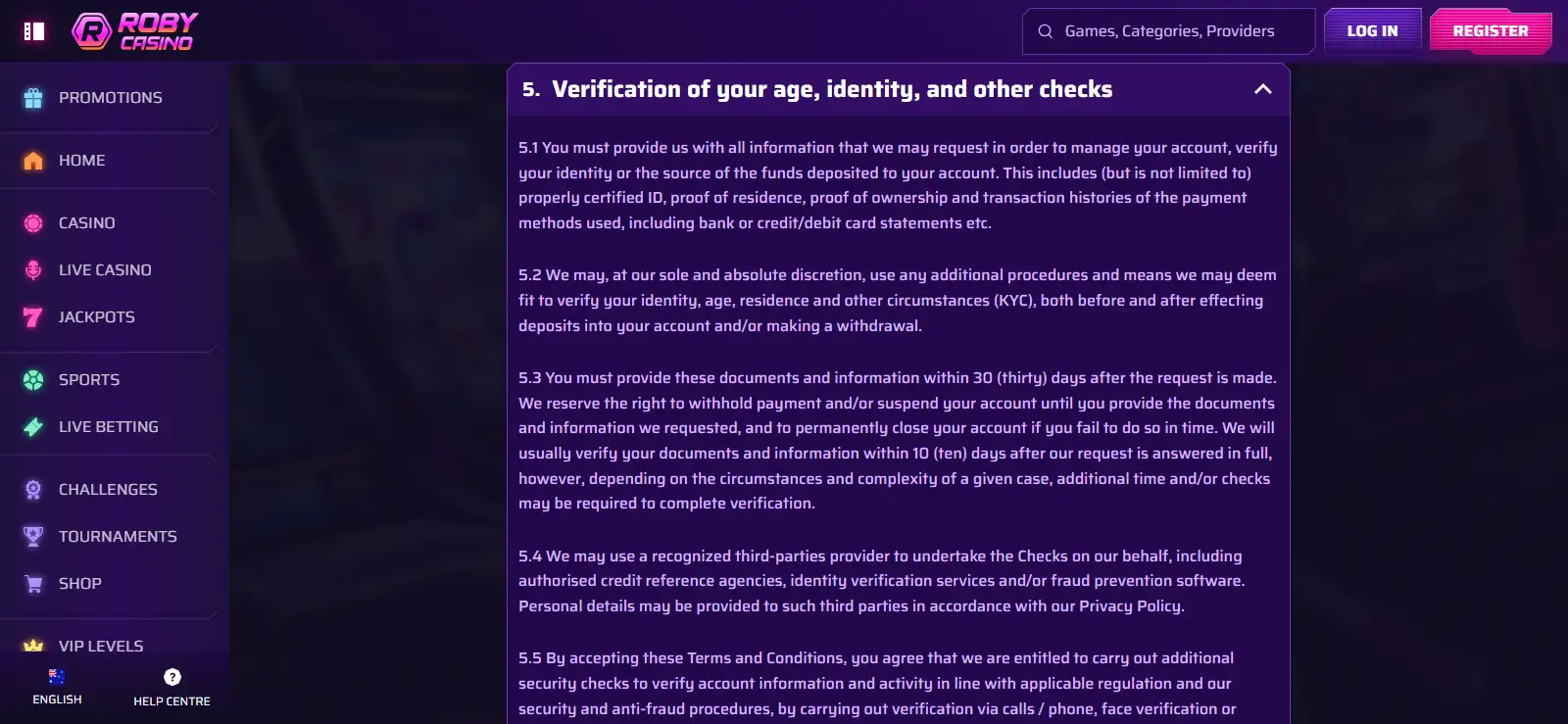
Table of Contents
- What Roby can request for KYC
- Roby’s 30-day response window is not the review time
- KYC can happen before or after deposits and withdrawals
- Why withdrawal requests often bring KYC into focus
- Account details should match the evidence you later provide
- Payment ownership is part of verification, not a separate formality
- What the current Terms do not promise
- Why a complete KYC response is more useful than sending extra documents
- How to read a Roby verification request
- Official KYC source
- How Roby verification can affect an Australian player’s payout timeline
What Roby can request for KYC
Section 5 of Roby’s Terms gives the clearest current description of verification evidence. It says customers must provide information requested to manage the account, verify identity or verify the source of funds deposited to the account. The listed evidence classes include properly certified identification, proof of residence, proof of ownership of the payment methods used and transaction histories, including bank or credit or debit card statements.
Those categories are broader than a one-document identity check. Identity proves who the customer is, residence helps confirm the address or location information associated with the account, and payment-ownership evidence links the funding method to the account holder. Transaction history or source-of-funds information can add a further layer when the operator needs to understand where deposited money came from.
Evidence classes in the current Terms
- Properly certified identity evidence
- Proof of residence
- Proof of payment-method ownership
- Transaction histories for payment methods used
- Information needed to verify source of funds
Roby’s 30-day response window is not the review time
Two different time periods appear in the verification clause and they should not be confused. First, customers must provide the requested documents and information within 30 days after the request is made. That is the response deadline for the customer, not a promise that the operator will take 30 days to review the file.
Second, once the request has been answered in full, Roby says it will usually verify the documents and information within 10 days. The Terms immediately qualify that timing by saying additional time or checks may be required depending on the circumstances and complexity of the case. The 10-day wording is therefore a usual processing statement, not a guaranteed maximum.
KYC can happen before or after deposits and withdrawals
Roby’s Terms allow additional identity, age, residence and other checks both before and after deposits and before or around withdrawals. That matters because a successful registration does not mean the account has completed every future verification requirement.
The operator can also use additional procedures it considers appropriate, and the Terms refer to recognised third-party providers, identity-verification services, credit-reference agencies and fraud-prevention tools. They also allow additional security checks through calls, phone verification, face verification or other methods required to confirm the account holder’s identity.
These clauses explain why KYC can feel different from one account to another. The published rules establish the categories and powers available to the operator, but they do not say that every customer will receive the same sequence of checks or that every listed method will be used in every case.
When checks may appear
- During account management
- Before or after deposits
- Before a withdrawal is released
- When payment ownership needs confirmation
- When additional security review is required
Why withdrawal requests often bring KYC into focus
The withdrawal section of Roby’s Terms gives the verification clauses practical force. It says the company may delay a withdrawal request while it checks identity, account balance, source of funds and compliance with the Terms. It can postpone payment until the verification procedures and checks have been completed successfully.
This does not mean every withdrawal will trigger a new KYC request. It means the operator reserves the right to require verification before releasing funds, so an account that has never been fully checked can encounter the process later. That is one reason payment ownership matters: a funding method that does not clearly belong to the account holder can create a separate verification issue even if the identity document itself is valid.
For withdrawal limits and processing rules, see Roby Casino Withdrawals Australia. KYC requirements concern identity, residence, payment ownership and related checks, while payout limits and processing conditions are separate account rules.
Account details should match the evidence you later provide
Roby’s registration rules require true and complete information, while the KYC section allows the operator to verify identity, age, residence and payment details. Those clauses connect directly. If registration information and later documents do not match, the verification process can require extra explanation or additional checks.
The practical implication is not to guess at address formats, names or other personal details during account setup. Use accurate details and update them if they change. The Roby Casino Registration Australia guide explains the account rules that come before KYC.
Payment ownership is part of verification, not a separate formality
The Terms specifically allow proof of ownership and transaction histories for payment methods used on the account. They also state elsewhere that the payment method used to fund the balance should belong to the customer. That makes payment ownership part of the identity-and-account relationship rather than a purely banking question.
Where a method has changed, a card has expired or an account uses more than one payment route, additional evidence may be needed to connect the transaction history to the same account holder. The Terms do not provide a universal checklist for every such case, so exact requests should be read from the live verification request rather than assumed in advance.
What the current Terms do not promise
Roby’s Terms do not promise that every case will be completed in exactly 10 days. They do not say that every customer will be asked for the same documents, nor do they guarantee that a withdrawal will be released immediately after a document is uploaded. The language is conditional because the operator can require additional time or checks when a case is more complex.
The same caution applies to document examples found elsewhere in the Terms. A refund clause gives examples such as passports, driving licences, identity cards, utility bills, bank statements and rental agreements, but that does not mean every item is mandatory in every KYC case. The broader Section 5 categories are the more reliable way to describe ordinary verification requirements.
KYC should be read as an account-control process. The relevant question on this page is whether the identity, residence and payment evidence requested by the operator is consistent with the information already attached to the account.
Why a complete KYC response is more useful than sending extra documents
The Terms frame verification around the information Roby asks for, so the goal is to answer the actual request completely rather than to upload the largest possible bundle of documents. If the request concerns identity, address, payment ownership or transaction history, the evidence needs to resolve that specific point and match the account record.
A complete response also matters for timing. Roby’s usual 10-day verification statement applies after a request has been answered in full, while the customer has 30 days to provide requested information. Sending material that does not address the requested category can therefore leave the review incomplete even when several files have been uploaded.
For the separate Australian regulatory question, see Is Roby Casino Legal in Australia? ACMA, Licensing and Player Context. This page stays focused on what the operator’s verification terms require from an account holder.
How to read a Roby verification request
If Roby asks for verification, start by identifying what category the request actually concerns: identity, address or residence, payment ownership, transaction history, source of funds or an additional security check. That prevents a common mistake where a customer sends more documents without addressing the specific point being verified.
Next, compare the request with the account information already on file. A document can be genuine and still fail to resolve a mismatch if the name, address or payment ownership does not align with the registration record. Finally, keep the published timeframes separate: the Terms give 30 days to supply requested information, while the usual review statement begins after the request has been answered in full.
Those steps describe how to interpret the operator’s published rules, not how to bypass verification. The Terms allow the company to suspend or withhold payment while required information is outstanding, so incomplete responses can extend the process rather than shorten it.
Official KYC source
For the broader brand overview, return to the Roby Casino Australia Review. Verification requirements can depend on the specific request, so the live request and current Terms should be read together.
How Roby verification can affect an Australian player’s payout timeline
Roby’s current Terms make verification a potential part of the payout process rather than a one-time registration formality. The operator can request identity, residence, payment-ownership, transaction-history and source-of-funds evidence, gives customers 30 days to answer a request, and says review is usually completed within 10 days after a full response while allowing longer handling for more complex cases. Because withdrawals can be delayed until checks are finished, the cleanest account history is one where registration details, identity evidence and payment ownership are consistent from the start.
Prepared by the Roby Casino editorial staff.